
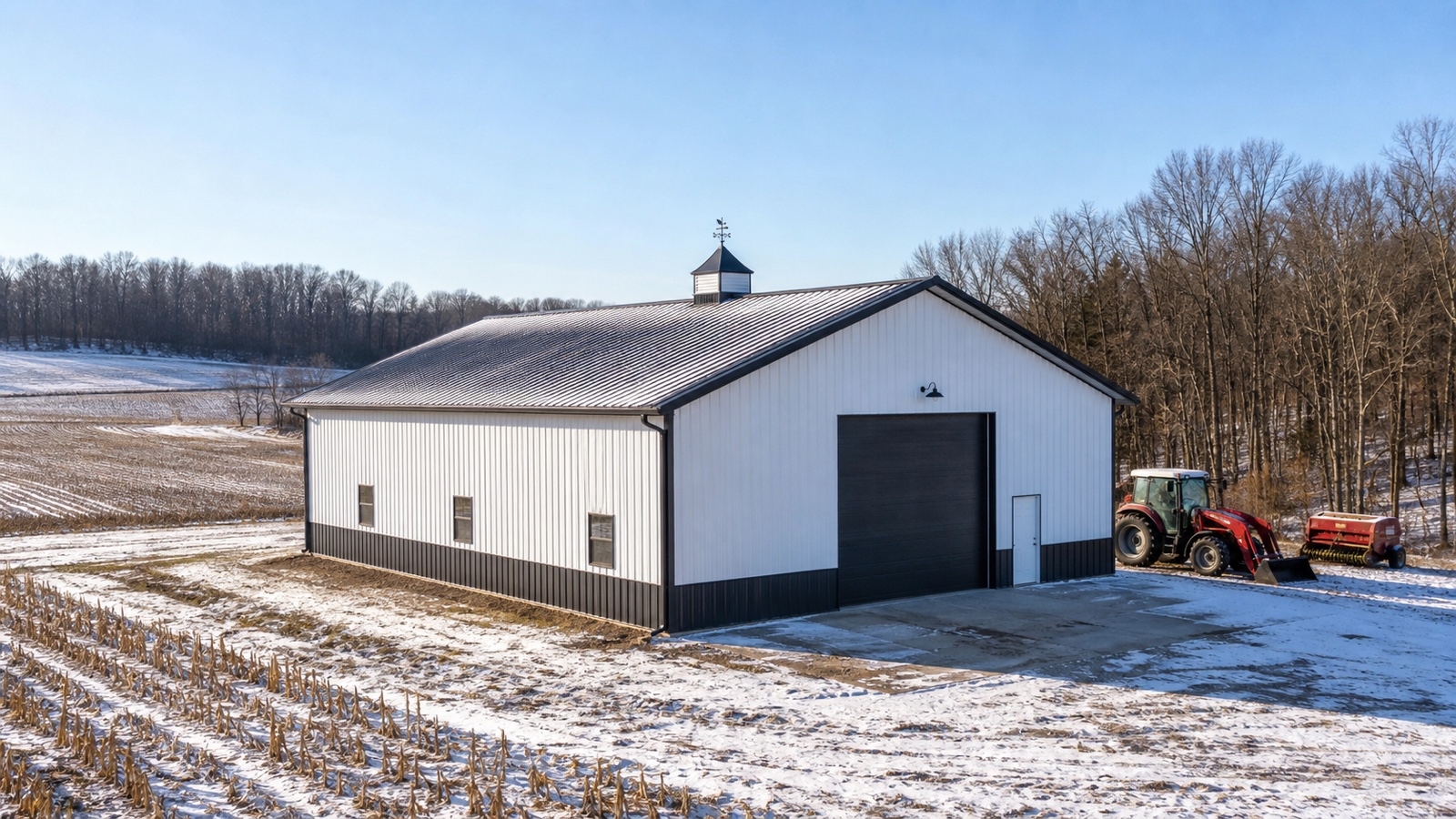
Ohio pole-barn prices cannot be reduced to a substantiated statewide average. Labor, site work, local design criteria, shell scope, doors, slab, utilities, and finish level all change the bid. Ohio law also treats qualifying agricultural buildings differently from residential and commercial work.
This guide shows how to evaluate sourced market examples, check the arithmetic, and confirm the Ohio-specific rules that affect a real quote.
Quick answer
PFN did not find a representative, public set of current Ohio bids that supports a statewide average. As one dated commercial benchmark, a published 40x60 contractor-built shell example is $35,000-$55,000. A 40x60 is 2,400 square feet, so that example equals about $15-$23 per square foot. It is a comparison point—not an Ohio quote—and its scope must be checked before use.
The biggest pricing swings usually come from:
- Shell-only vs finished use
- Where in Ohio you're building
- Snow load requirements in your county
- Concrete, insulation, and electrical
- Permits and site prep
Why Ohio pricing is a range, not a number
Post-frame construction — the method behind pole barns — uses large posts set into the ground or on concrete piers instead of a continuous foundation. That's what keeps the base cost low and construction fast.
But "pole barn" describes everything from a hay shed to an insulated, heated workshop, which is why Ohio quotes for the same footprint can land tens of thousands of dollars apart.
For a national baseline, see our 2026 pole barn cost guide. Planning a 40x60 specifically? The 40x60 pole barn cost guide breaks that size down in detail.
What drives pole barn prices in Ohio
1. Where in Ohio you build
Labor is priced regionally. Builders serving the Columbus, Cleveland, and Cincinnati metros generally carry higher labor and overhead costs than crews based in rural northwest or eastern Ohio.
The flip side: a builder traveling a long distance to a rural site may add travel or mobilization charges.
Two identical buildings in different parts of the state can come back with genuinely different quotes — and both can be fair.
2. Snow load in northern counties
Northern Ohio — especially the northeast snowbelt east of Cleveland — carries higher snow load requirements than the southern half of the state.
Higher snow load means heavier-duty truss design, and heavier trusses cost more. A quote engineered for a southern Ohio snow load is not directly comparable to one engineered for Ashtabula County — confirm every quote is designed for your county's actual requirement.
3. Concrete
A slab may be excluded from a shell quote. Obtain a site-specific concrete proposal stating area, thickness, base preparation, reinforcement, vapor control, concrete strength, finish, joints, and intended loads.
4. Insulation and electrical
Insulation and electrical are not automatically included in a base quote. Define climate-appropriate assemblies, service capacity, panels, circuits, lighting, outlets, and heating or cooling before comparing bids.
5. Permits
Permit requirements, submittals, inspections, and fees are set by the authority responsible for the build address. Ask that office for the current answer rather than relying on a statewide fee range.
And in Ohio, whether you need a permit at all depends on what the building is for. That's the agricultural exemption.
Ohio's agricultural exemption, in plain English
Ohio Revised Code 3781.061 limits application of certain building provisions to agricultural buildings and defines important exceptions. Whether a project qualifies depends on its actual use and the responsible local authority's interpretation.
The rule exists because farm buildings have historically been treated as part of agricultural operations rather than as regulated construction. For a working farm putting up a machinery shed, it saves time and paperwork.
To find out whether it applies to you, contact your county building department before you sign anything. Interpretations vary by county and sometimes by township, so get an answer for your specific parcel and intended use — ideally in writing.
Now the warning.
The exemption does not cover residential or commercial use. A "barn" you intend to use as a workshop for a business, a living space, or a barndominium is not an agricultural building, no matter what the exterior looks like.
Using an agricultural classification for residential or other nonqualifying use can create code, occupancy, insurance, and resale problems. Confirm the classification in writing with the local authority and relevant insurer before construction.
If there's any residential or commercial use in your plans, permit it as such from the start.
Shell vs finished: two different budget conversations
Shell-oriented build
May include: Frame / Siding / Roof / Basic openings
The cited commercial benchmark for a 40x60 shell is $35,000-$55,000, or about $15-$23 per square foot. It is not Ohio-specific and should be used only to check the order of magnitude and scope of local bids.
Finished, usable building
May also include: Concrete slab / Insulation / Electrical and lighting / Upgraded doors / Windows / Ventilation / Better finish details
Ask bidders to price the same finished specification; PFN does not have an Ohio data set that supports a statewide finished-price range.
Those are two very different projects, even though the footprint is identical.
Common mistakes buyers make
Using the ag exemption for a non-agricultural building
A shop, business, or living space built under an ag exemption creates insurance and resale problems that cost far more than the permit would have.
Comparing a shell quote against a finished quote
They are not the same product. Confirm what each quote includes before comparing numbers.
Ignoring snow load when comparing builders
A truss spec'd for southern Ohio is cheaper than one spec'd for the snowbelt. Make sure every quote is designed for your county.
Leaving concrete out of the budget
A shell quote may omit the slab entirely. Put the slab specification and responsibility in writing before comparing totals.
Questions to ask Ohio builders
- Does this quote include the concrete slab?
- What snow load are the trusses engineered for, and does that meet my county's requirement?
- Have you built in my county before, and who handles the permit process?
- Does my intended use qualify for the agricultural exemption — and should it?
- What exactly does "finished" include at this price?
- Are site prep and travel charges included or separate?
Final takeaway
The happiest pole barn buyers in Ohio do three things: decide how the building will actually be used before collecting quotes, confirm every quote is spec'd for their county's snow load and permit rules, and budget for concrete, insulation, and electrical up front.
Costs genuinely vary by region, spec, and finish level. Use documented examples to frame questions and let comparable local quotes set the real number.
Frequently Asked Questions
How much does a 40x60 pole barn cost in Ohio?▾
PFN did not find a representative Ohio bid data set. One cited commercial shell example is $35,000-$55,000, equal to about $15-$23 per square foot for 2,400 square feet. Obtain comparable Ohio quotes for the same design and scope.
How much does a 30x40 pole barn cost in Ohio?▾
PFN cannot support a statewide 30x40 average from a representative Ohio data set. A 30x40 is 1,200 square feet; use that area to check the arithmetic in local shell and finished quotes after confirming what each includes.
Do I need a permit to build a pole barn in Ohio?▾
Ask the building authority responsible for the property. Ohio law treats qualifying agricultural buildings differently, but use, location, and local administration matter. Do not assume an exemption applies to residential or commercial use.
Why do pole barn quotes vary so much in Ohio?▾
Quotes vary with region, design loads, site conditions, size, openings, slab, utilities, finish level, and exclusions. Two different totals can both be reasonable when they describe different scopes, which is why PFN recommends a single written project brief for every bidder.
Compare Ohio pole barn builders
The fastest way to turn these ranges into a real number is quotes from builders who work in your county. Browse pole barn builders in Ohio, or see pole barn and post-frame builders by state if your project sits near a border.