
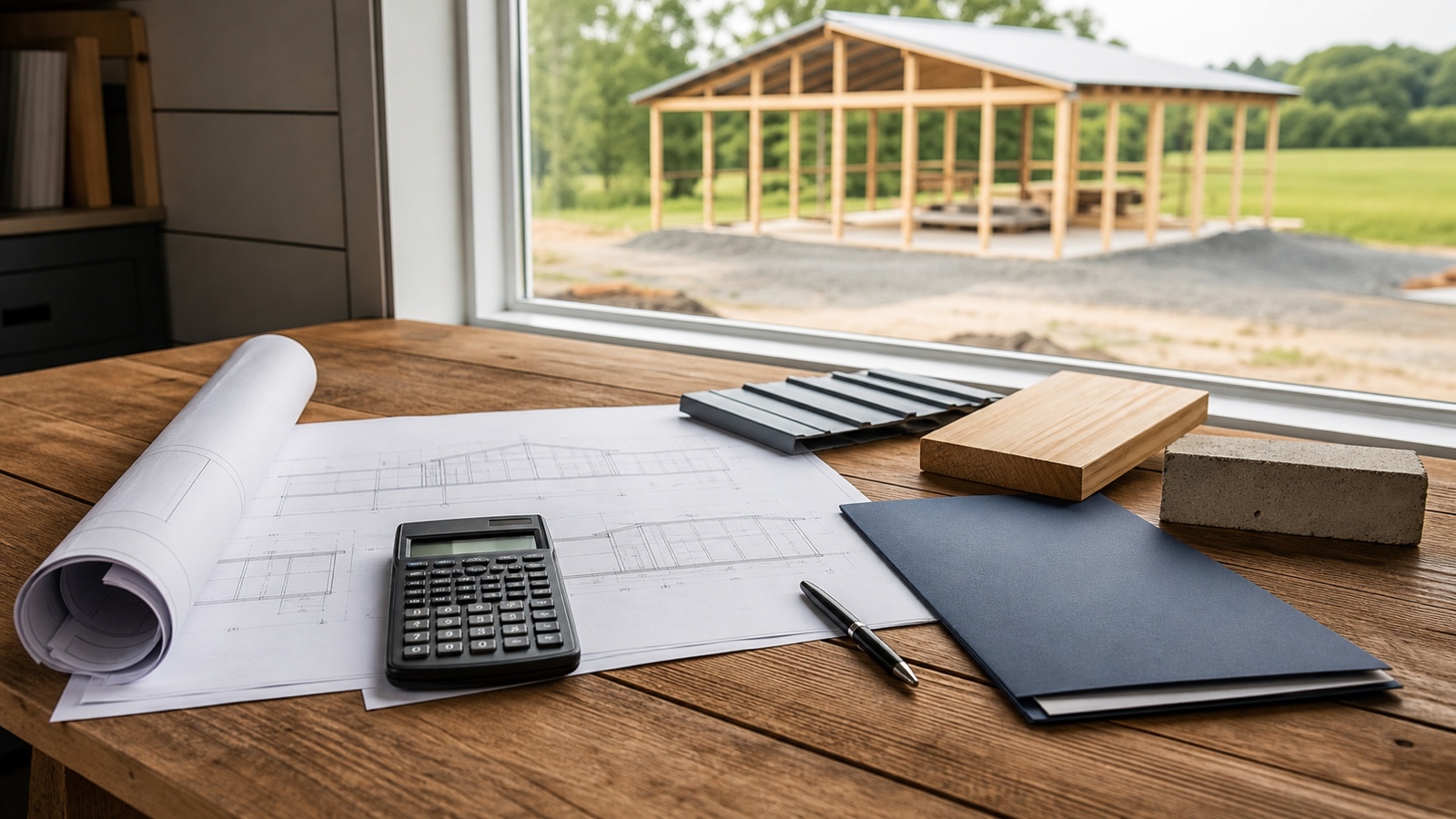
Most people planning a pole barn spend months on size, spacing, and door placement before they seriously look at how they are going to pay for it.
That order makes sense emotionally. It causes problems practically, because the financing path you qualify for often changes what you can realistically build.
A post-frame building — a structure framed with large posts set in the ground or on piers rather than a continuous concrete foundation wall — does not fit neatly into how many lenders categorize property. Some treat it as a home improvement. Some treat it as new construction. Some treat it as agricultural equipment.
Those three categories carry very different terms, and nobody at the loan desk will explain the difference unless you ask.
Quick answer
Pole-barn financing can include a personal loan, home-equity loan or HELOC, construction loan, agricultural financing, builder-arranged program, cash-out refinance, or cash. The terms, collateral, draw process, maximum amount, and required borrower contribution vary by lender, borrower, property, and intended use. Compare written loan estimates rather than relying on a universal term or down-payment range.
The right option depends less on the building and more on three things:
- Whether you own the land outright
- Whether the building is personal use, farm use, or income-producing
- Whether you need one lump sum or money released in stages
Why pole barn financing works differently than a mortgage
A mortgage is secured by a house that appraisers can compare to dozens of similar houses nearby. That comparability is what makes the loan easy to approve.
A detached post-frame building rarely adds value to a property dollar-for-dollar, and a barndominium may have almost no comparable sales in its market. Lenders price that uncertainty into the deal.
This is why two people with nearly identical credit can get very different answers on the same building. It is also why walking in with documentation and a clear use case matters more here than it does on a car loan.
The six ways people finance a pole barn
1. Personal loan
How it works: An unsecured installment loan based on your credit and income. No collateral, no appraisal, no lien on your property. Funds arrive as a lump sum.
Who it suits best: Smaller projects, strong credit, and buyers who want speed or who do not want a lien attached to their land.
Watch out for: An unsecured loan does not use property as collateral, but rate, term, fees, and limits are lender-specific. Compare annual percentage rate, total payments, and prepayment terms.
2. Home equity loan or HELOC
How it works: You borrow against the equity in your home. A home equity loan is a fixed lump sum. A HELOC is a revolving line you draw from as needed.
Who it suits best: Buyers with substantial equity, and projects where costs may shift — a HELOC lets you draw only what you actually spend.
Watch out for: Your home is the collateral. A cost overrun on a detached workshop becomes a lien on the house you live in. HELOC rates are also commonly variable, so the payment you model today may not be the payment you make in year six.
3. Construction loan
How it works: Funds are released in stages as work progresses — typically after site prep, after the shell is up, after major systems are in. An inspection usually triggers each draw. Many convert to a permanent loan once the building is complete.
Who it suits best: Larger builds, barndominiums, and anything where the finished structure is meant to be permanent living or working space.
Watch out for: This is the most paperwork-heavy option on the list. Your builder has to be willing to work on a draw schedule, and not every small post-frame contractor is. Ask before you sign a build contract, not after.
4. Agricultural or farm credit
How it works: Lending designed for farm and income-producing agricultural use. Underwriting looks at the operation's income and the building's role in it, not just your personal credit.
Who it suits best: Working farms, equipment and hay storage, livestock buildings, and any structure that supports revenue.
Watch out for: Use has to be genuine. Financing a building as an agricultural asset and then finishing it as a residence or a hobby garage can conflict with the loan terms and, separately, with local zoning and any ag exemption — a property tax reduction some states grant to land in active agricultural production.
5. Builder or dealer financing
How it works: The builder or kit supplier arranges financing through a lending partner, often as part of the same conversation as the quote.
Who it suits best: Buyers who value one point of contact, and those who have had trouble getting approved through a bank.
Watch out for: Convenience is real, but it is not free. Get the full terms in writing — rate, term, total interest paid, prepayment penalties — and compare them against a quote from your own bank or credit union. A bundled monthly payment can obscure a higher rate. This is also the option where it is hardest to tell whether you are shopping the market or just shopping one lender.
6. Cash-out refinance
How it works: You replace your existing mortgage with a larger one and take the difference in cash.
Who it suits best: Owners with strong equity whose current mortgage rate is at or above prevailing rates, and who want the longest possible term.
Watch out for: You are resetting your primary mortgage to fund a barn. If your existing rate is low, refinancing the entire balance to access a fraction of it is usually a bad trade. Closing costs apply to the whole loan, not just the cash you take out.
Pole barn financing options compared
| Option | Secured or unsecured | Typical term | Relative rate | Best for |
|---|---|---|---|---|
| Personal loan | Unsecured | Varies by lender | Compare APR and total payments | Smaller builds, speed, no property lien |
| Home equity loan | Secured by home | Varies by lender | Often fixed, but confirm | Fixed budget, sufficient equity |
| HELOC | Secured by home | Varies; draw then repay | Lower, often variable | Phased or uncertain costs |
| Construction loan | Secured; lender-specific | May convert at completion | Varies | New construction and larger builds |
| Ag or farm credit | Secured; eligibility varies | Varies | Varies by program | Qualifying farm ownership or operation uses |
| Builder or dealer financing | Varies by program | Varies widely | Varies widely | One-stop convenience |
| Cash-out refinance | Secured by home | Resets mortgage term | Lower, but on full balance | High equity, high existing rate |
Barndominium financing is its own problem
A barndominium — a post-frame building designed as living space, sometimes combined with a shop or garage — is where financing derails most often.
The reason is appraisal. An appraiser has to support the value with comparable sales, and in rural markets there may be only a handful of barndominiums sold in recent years, or none. Without comps, the appraisal can come in far below the build cost, and an otherwise approvable loan collapses.
This is not a credit problem. Buyers with excellent credit hit it constantly.
Three things help:
Find a lender experienced with rural or non-traditional construction. Local banks, credit unions, and farm credit institutions often have appraisers who have valued these buildings before. A national online lender frequently has not.
Ask how the appraised value affects your required contribution. A lender may limit the loan relative to appraised value or project cost. Get the calculation in writing before committing to a build contract.
Get the appraisal question answered before you commit. Ask a prospective lender directly: how will you appraise this, and have you closed one before? Do that before you sign a build contract or put down a deposit. Our barndominium cost guide covers what these projects actually run, which is the number your lender will be testing against.
Financing a shell vs financing a finished building
Shell-oriented borrowing
Covers: Frame / Siding / Roof / Basic openings
Finished-building borrowing
Also covers: Site prep / Slab / Insulation / Electrical / Plumbing / HVAC / Interior finish / Doors and windows
Buyers routinely finance the first list and then discover the second list has to come out of pocket, one credit card at a time, over three years.
Those are two very different loan applications. Decide which one you are making before you request an amount. The pole barn cost guide breaks down what falls into each bucket.
What lenders will ask you for
Have these ready before the first conversation. Showing up with them shortens the process and materially improves how the file is read.
- Proof of land ownership — deed or current mortgage statement
- Recent property tax records
- Two years of tax returns; W-2s or 1099s
- Recent pay stubs or profit-and-loss statements if self-employed
- Bank statements, usually two to three months
- A signed, itemized quote or build contract from your builder
- Building plans or engineered drawings
- Site plan showing where the structure will sit
- Permit status or confirmation of local approval
- Stated use of the building — personal, agricultural, or commercial
- Contractor license and insurance documentation
- For construction loans: the builder's proposed draw schedule
Common mistakes buyers make
Shopping the building before shopping the money
Your approved amount and structure shape what you can build. Reverse the order and you may redesign twice.
Assuming a detached building adds its cost to the appraised property value
Cost and appraised value are different measures. Ask the lender how it will value the completed building and what happens if the appraisal is below project cost.
Taking the first financing offer that comes with the quote
Builder-arranged financing may be competitive or may not be. You cannot know without a second quote.
Borrowing only for the shell
The finish work is where budgets break. Fund the building you actually intend to use.
Not disclosing the true use
Calling a residence an ag building to get better terms creates loan, tax, and zoning exposure that surfaces later.
Questions to ask a lender
- Is this loan secured, and by what?
- What is the full term, and is the rate fixed or variable?
- What down payment do you require for this specific use?
- How will you appraise a post-frame building or barndominium, and have you financed one before?
- Are funds released as a lump sum or in draws?
- If draws, what triggers each one, and who inspects?
- Are there requirements my builder has to meet?
- What are the closing costs and origination fees, in dollars?
- Is there a prepayment penalty?
- Does the loan cover site prep, slab, and interior finish, or shell only?
- What is the total interest paid over the life of the loan?
- What would cause this loan to fall through after preapproval?
Final takeaway
The buyers who finance these projects smoothly tend to do the same three things:
- Get preapproved before finalizing the design, so the budget drives the drawings instead of the reverse.
- Collect two or three quotes — one from their own bank or credit union, one from a lender experienced with rural construction, and only then compare the builder's offer against those.
- Borrow for the finished building, not the shell, because the finish work does not get cheaper by being deferred.
Find a builder before you finalize the loan
Almost every lender on this list will want an itemized quote and a scope of work before they will commit to a number. Start by comparing pole barn and post-frame builders by state in the directory, and use our list of questions to ask a post-frame builder to get quotes detailed enough that a loan officer can actually work from them.
Frequently Asked Questions
Can you finance a pole barn with no money down?▾
It depends on the loan, collateral, lender, borrower, and program. Ask for the required cash contribution, closing costs, reserve requirements, and whether the loan is limited by project cost or appraised value.
How long can you finance a pole barn for?▾
The term depends on the product and lender. A construction loan may have a construction phase and then convert or require separate permanent financing; home-equity, personal, agricultural, and refinance products follow their own disclosures. Compare total payments, not term alone.
Is it hard to get a loan for a barndominium?▾
It can be harder when a lender or appraiser has limited comparable sales or experience with the property type. Ask how the project will be classified and appraised, what documentation is required, and what happens if appraised value is below build cost.
What is the maximum I can borrow for a pole barn?▾
There is no universal maximum. It depends on lender limits, income and credit, collateral, appraisal, project classification, use, and program eligibility. Request a project-specific preapproval before finalizing the design.
Should I use my builder's financing?▾
It is worth evaluating, not worth accepting automatically. Ask for the rate, term, total interest, and any prepayment penalty in writing, then compare that against a quote from your own bank or credit union. Convenience is a real benefit; it is just not always the cheapest one.