
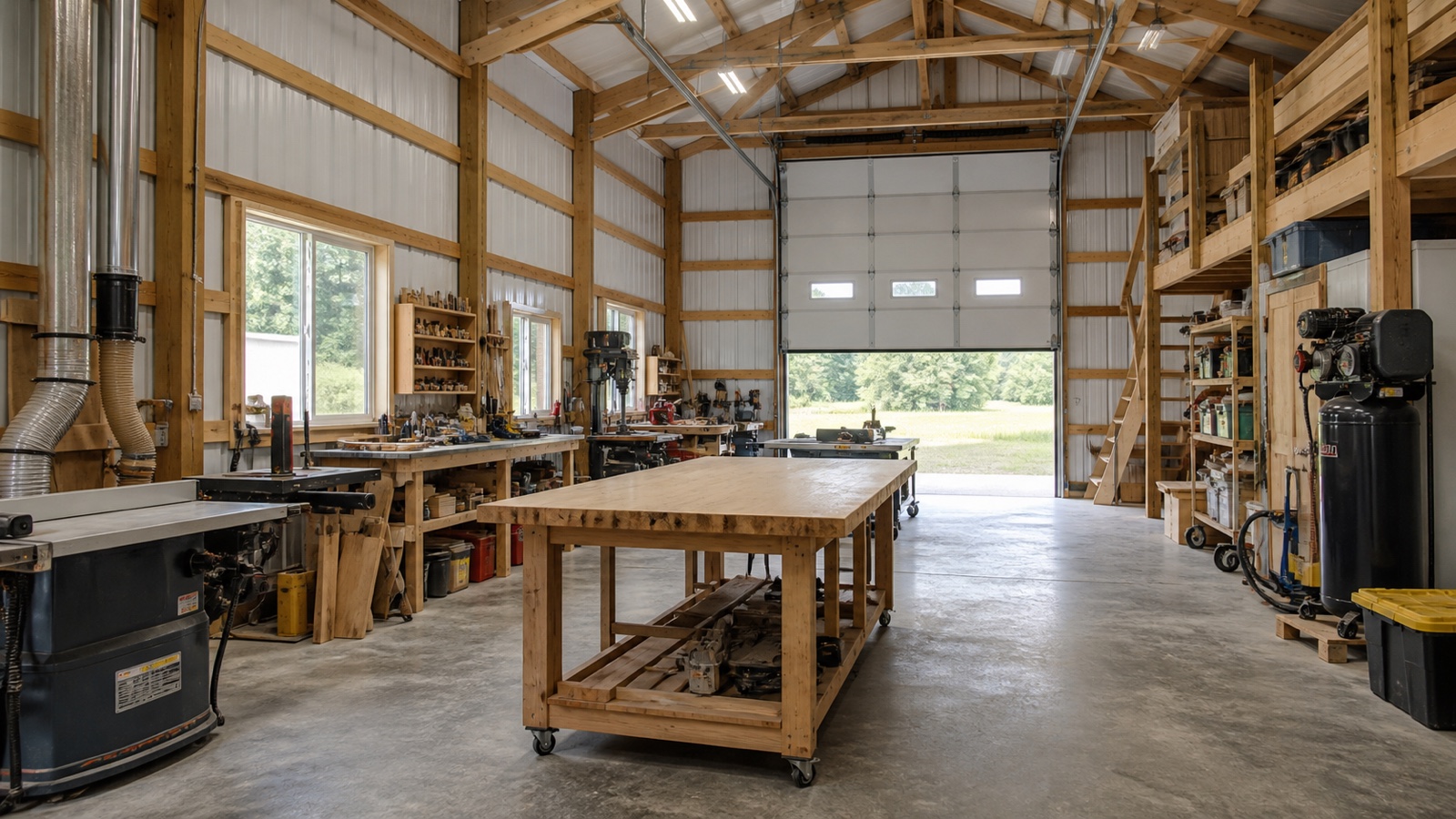
A workshop is the kind of post-frame project where the use case drives almost everything — size, power, insulation, layout, even the door choices.
Two 30x50 workshops can look identical from the road and have completely different price tags. One is a heated, well-lit hobby shop with a finished floor and a clean tool wall. The other is a bare metal shell that will eat power tools alive every winter.
If you're planning a post-frame workshop — whether that's a woodworking shop, a metal fab space, a small-engine shop, a side business, or just a clean place to actually finish projects — this guide walks through the decisions that drive the budget and the questions worth asking before you sign anything.
Quick answer
A post-frame workshop's price is shaped less by the footprint and more by:
- How much of the year you want to use it comfortably
- The kind of work you'll do inside
- Whether power, insulation, and the slab match that work
- Door and window choices
- Ceiling height
- Site prep and access
A 30x40 hobby shop and a 30x40 working shop are not the same build.
How big should a post-frame workshop be?
The right size depends on what kind of work you're planning to do and how much storage that work generates.
These are rough starting points buyers tend to land on:
24x30 (720 sq ft)
- Tight but workable for a focused hobby — woodworking, small projects, mechanical work on one vehicle at a time.
- Limited room for a separate storage or assembly zone.
- Good entry size if budget is tight and the lot is small.
30x40 (1,200 sq ft)
- The most common "real workshop" footprint.
- Enough room for a main work zone, a tool wall, an assembly area, and storage.
- Comfortable for a single-vehicle bay plus a dedicated shop area.
30x50 or 40x60 (1,500–2,400 sq ft)
- Production-grade or side-business territory.
- Room for multiple work zones, large equipment, finishing area, and material storage.
- Often the size where buyers stop wishing they'd gone bigger.
The most common regret buyers report is going one size down to save money and outgrowing the space within a year or two.
Cost drivers that actually move the budget
These are the categories where workshop budgets swing the most.
1. Insulation and climate control
This is the single biggest factor that separates a shell from a usable year-round shop.
A workshop that's only comfortable from May to September gets used a fraction of the time you imagined when you signed the contract. If you're in a cold-winter or hot-summer climate, insulation isn't a luxury — it's the difference between a real shop and an expensive storage building.
Plan for it from the start. Retrofitting insulation later is doable, but it's never as clean or as cheap as designing for it up front.
2. Electrical capacity
Workshops eat power. Even a modest woodshop with a dust collector, a table saw, and a couple of dedicated 20-amp circuits will outgrow a basic garage-style electrical setup quickly.
Things to think through before quoting:
- Whether you'll run 220V tools (cabinet saws, welders, compressors, mini-splits)
- Number and placement of outlets
- Sub-panel sizing
- Lighting layout (workshops benefit from much more light than typical garages)
- Future expansion (EV charging, additional tools, heating)
3. Concrete slab spec
A slab built for storage is not the same as a slab built for heavy tools, lifts, or impact work.
Workshops often benefit from:
- Thicker slabs in equipment zones
- Reinforcement appropriate to the load
- A vapor barrier, especially for finish work or comfort
- Thoughtful slope and drainage if washing equipment or vehicles
4. Ceiling height
A 9–10 foot ceiling works for a basic shop. The moment you add a lift, large equipment, an overhead crane, or want to hang material storage, you need more.
Going taller affects framing, doors, insulation cost, and heating load — but it's another one of those decisions that's almost impossible to fix later.
5. Doors and openings
Workshop door requirements look different from garage doors:
- A walk door near where you actually enter
- An overhead door large enough to move equipment or material in and out
- Windows for natural light and ventilation (often more than a garage would have)
- Sometimes a second overhead door for through-flow
6. Layout-driven framing
If you know you want a clear span for equipment, an unobstructed lift area, or a future mezzanine, that has to be designed in early. It's a framing conversation, not a finish conversation.
7. Ventilation
This is often overlooked at quote time and becomes a real problem after move-in.
Woodworking, finishing, welding, painting, and small-engine work all generate dust, fumes, or heat that need to leave the building. A shop without ventilation is one you stop using for half the things you bought it for.
Shell vs working shop: the conversation to have early
Just like with garages, a workshop quote can mean very different things depending on what's included.
Shell-oriented quote
- Frame
- Siding
- Roof
- Basic openings
- Often no slab, no electrical, no insulation
Working-shop quote
- Slab and prep
- Insulation
- Electrical rough-in (sometimes finish)
- Larger or upgraded doors
- Adequate windows
- Better lighting layout
- Ventilation considered
Two quotes for the same square footage can differ by a large multiple depending on which conversation each builder thinks they're having. Ask early and get it in writing.
Common mistakes buyers make
Buying the size that fits today
Workshop owners almost universally wish they'd gone larger. Tools, material, and projects expand to fill the space.
Underestimating electrical
A shop with too few circuits, no 220V, and undersized service is a frustration generator. Spec it for what you might run in five years, not just today.
Treating it like a garage
A workshop is a different building than a garage, even if the outside looks similar. Light, power, ventilation, and layout matter much more.
Skipping insulation to save money
The cheapest part of the year is when you're comparing quotes. The most expensive part is in February when the shop is unusable and you're paying to fix it.
Not planning for noise and neighbors
If your shop will run loud equipment, think about door direction, window placement, and where the building sits on the lot. Small choices early prevent friction later.
Questions to ask any builder
- Is this a shell quote or a finished-shop quote?
- What slab spec is assumed, and is it appropriate for the equipment I plan to use?
- What ceiling height is included? What does it cost to go taller?
- What insulation, if any, is included?
- What electrical is included — rough-in, finish, sub-panel?
- What doors and windows are quoted, and at what sizes?
- What ventilation is planned for the building's intended use?
- How is the building sited for drainage, wind exposure, and access?
- What's the realistic timeline from contract to usable space?
Final takeaway
A post-frame workshop is one of the highest-leverage buildings you can put on a property — but only if it's designed for how you'll actually work in it.
The buyers who end up the happiest tend to make three decisions early:
- Go one size larger than they think they need.
- Spec the electrical and insulation for the work, not the budget.
- Treat the slab, ceiling height, and ventilation as structural decisions, not finishes.
Get those three right and the rest of the build follows naturally.
Frequently Asked Questions
What size post-frame workshop do I actually need?▾
Start with an equipment and workflow plan rather than a universal size. Draw machines, benches, storage, vehicle paths, doors, maintenance clearance, and material movement at scale, then compare footprints and the price of future expansion.
How much does it cost to insulate a post-frame workshop?▾
Insulation cost depends on climate zone, code, assembly, R-value, air and vapor control, walls versus roof or ceiling, and material. Plan the complete enclosure before construction if the shop will be conditioned; the U.S. Department of Energy's climate guidance is a useful starting point, but the local designer must specify the assembly.
What electrical service does a workshop need?▾
A qualified electrical designer or electrician should calculate the load from lighting, receptacles, HVAC, welders, compressors, lifts, dust collection, chargers, and future equipment, then check the property's available service. Equipment voltage alone does not determine the required panel size.
Do I need a permit for a post-frame workshop?▾
It depends on the build address, size, and use. Building, zoning, electrical, plumbing, mechanical, septic, driveway, floodplain, and fire requirements may be handled separately. Check with each responsible local authority before finalizing the site or design.
What's the difference between a workshop and a garage?▾
Functionally, a workshop is built around doing work: more outlets, more light, higher-spec slab in tool zones, better ventilation, and often a layout designed around a workflow. A garage is built around parking and storage: vehicle-sized doors, basic lighting, standard slab, less electrical demand. The shells can look similar from outside, but the inside of a workshop is a more demanding building to spec correctly.
Ready to compare workshop builders?
Browse pole barn and post-frame builders by state on Post Frame Network and start comparing companies that handle workshops, shops, and multi-use post-frame projects. Most builders who do garages also do workshops — but the right one for your project is the one who asks how you'll use the space before quoting it.